

The Clay Library: The Recovery of the Real Sky in Nineveh
Many times, when we speak of Astrology, we are led to think of abstract concepts or modern systems. However, the truth about astrology is not a subjective interpretation: it is engraved in clay.
Literally preserved, impressed, recorded by human hands that observed the sky with precision and reverence.
To understand why here, in the Sidereal Way, we defend the return to the Real Sky, we need to travel to the 7th century BCE, in ancient Mesopotamia, not only as a historical exercise, but as a reunion with the origin of the human gaze upon the cosmos.
There, King Ashurbanipal not only built the first great library in history, in the city of Nineveh, but preserved something even more valuable: the essence of True Sidereal Astrology that we recover today.
A knowledge that was not born from abstraction, but from the direct, patient, and continuous observation of the firmament.
The Cradle of Knowledge: Nineveh and the Assyrian Empire
At the heart of what we know today as Iraq, there existed the majestic capital of Nineveh, not only a political center, but a true axis of knowledge of the ancient world.
It was there that the Assyrian king Ashurbanipal, who took pride as much in his bravery in battle as in his literary erudition, decided to gather all the knowledge available in his time. Not as accumulation, but as preservation of what was considered essential to understand the order of the world.
Unlike other kings, Ashurbanipal knew how to read and write in complex languages such as Sumerian and Akkadian. He sent scribes throughout his empire to collect, copy, and translate sacred, scientific, and literary texts.
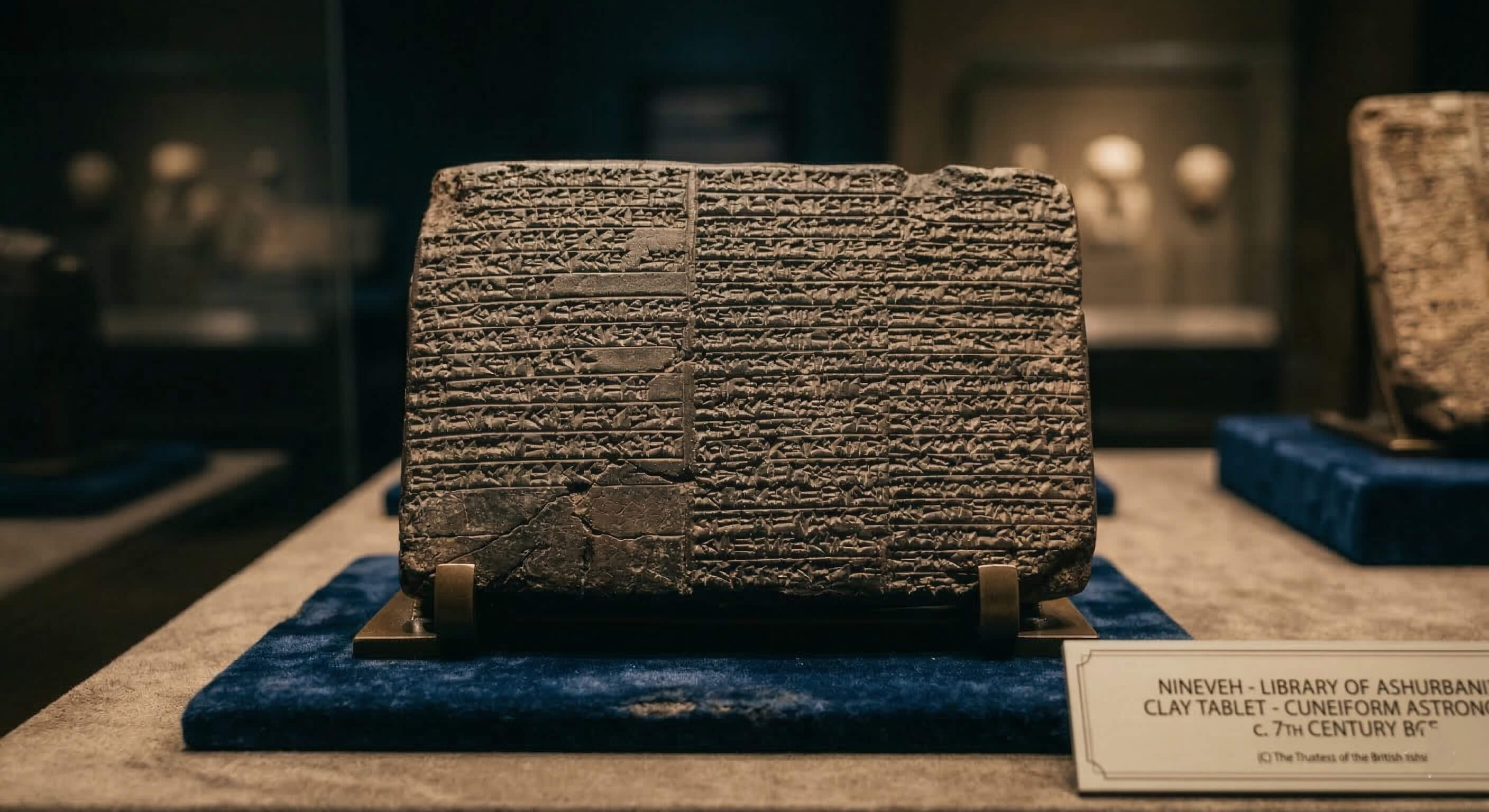
The result was a collection of more than 25,000 clay tablets, found by British archaeologists in the 19th century and preserved today, for the most part, in the British Museum.
The Sumerian, Akkadian, Assyrian, and Babylonian peoples, who inhabited the “land between rivers” (Mesopotamia), were the first to systematize the observation of the cosmos, not as superstition, but as an encyclopedic science that united astronomy, mathematics, medicine, and symbolic perception of reality.
Cuneiform Writing and the Recording of Truth
The writing used on these tablets is called cuneiform. It was made with a wedge-shaped stylus, pressed against the still moist clay, which was then baked in ovens to last for eternity. It was this durability that allowed the “Truth of the Stars” to reach us.
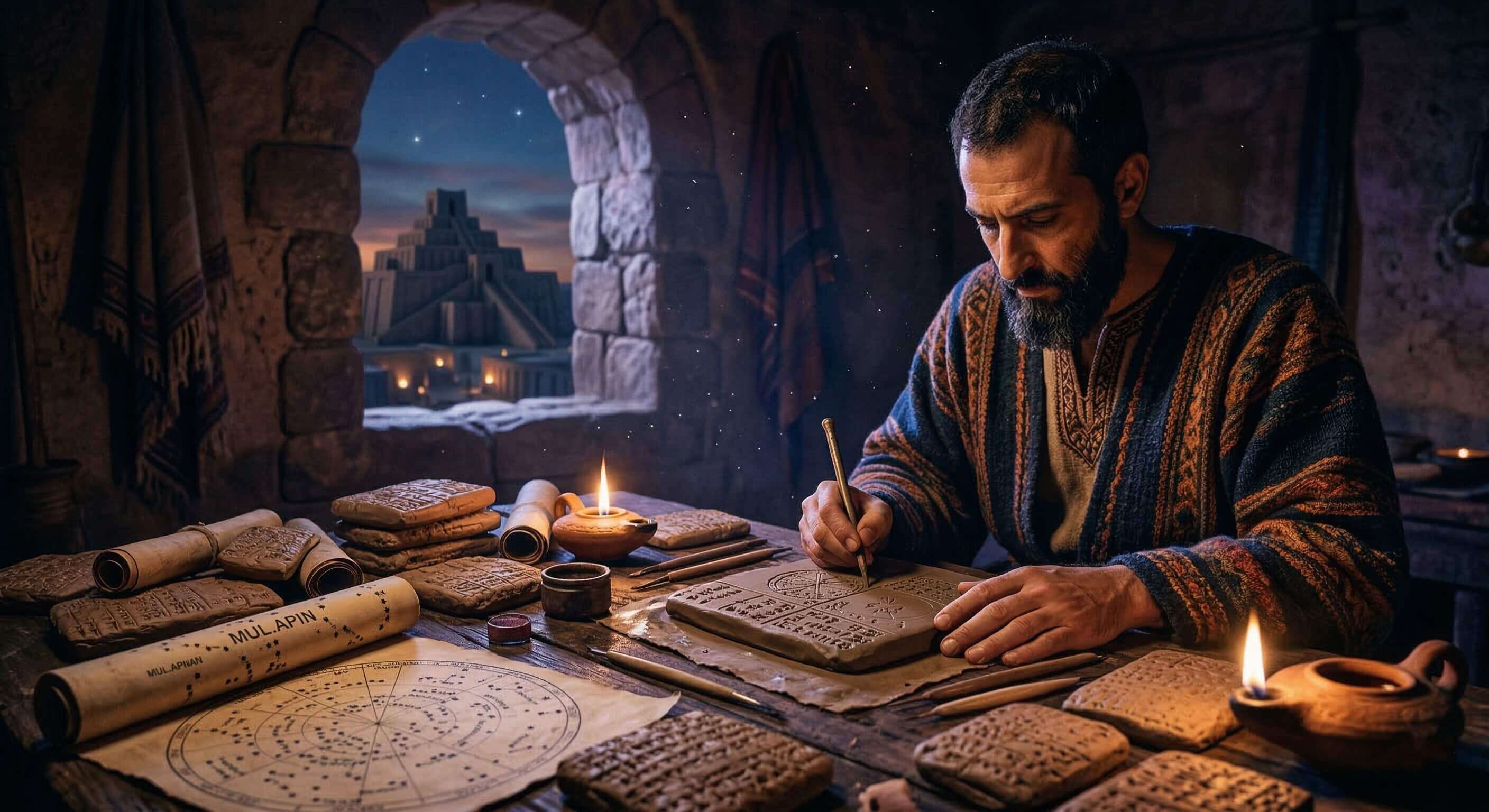
In the library of Nineveh, Astrology was not treated in a superficial way. It was side by side with medical manuals, codes of law, and guides about the natural world.
For the Assyrians, the sky was the great mirror of divine order, and each planetary movement was a piece of data that needed to be recorded with precision. They did not observe the sky only to register it, they observed it to understand how the invisible manifested in human life.
Enuma Anu Enlil and MUL.APIN: Sidereal Astronomy in Detail
Within this collection, two groups of texts are fundamental:
- Enuma Anu Enlil
A series of about 70 tablets that compiled thousands of celestial observations. Here, the priest-astronomers recorded eclipses, the brightness of stars, and the movement of the planets.
They sought patterns of cause and effect, but not in a mechanical way. They wanted to understand how certain celestial configurations were reflected in events on Earth. It was a continuous attempt to decipher the language of the cosmos.
- MUL.APIN
This is, perhaps, the most important document for True Sidereal Astrology. Dated approximately to 1000 BCE (although it reflects much older traditions), it lists the constellations that the Sun and the Moon pass through along their path.
And here is the crucial detail: it describes the sky exactly as it is seen by human eyes, based on fixed stars and not on artificial seasonal divisions. It is in these tablets that we find the evidence that astrology was originally, by nature, sidereal and based on the real sky.
They respected the irregular size of the constellations and the true position of the celestial bodies in the firmament. They respected the sky as it presents itself, not as it could be simplified.
And this changes everything. Because, in practice, it means that the sky was not made to fit into perfect divisions, but to be observed in its living complexity.
The “Serpent God” in the Sky of Ashurbanipal
A common question arises when we look at the past: was Ophiuchus considered a “sign” for the Assyrians?
To answer this, we need to understand that, for the Assyrians, there was no separation into the 12 fixed divisions that exist today. They did not use abstract “signs”; they observed real constellations of varying sizes. The idea that there are only “12 signs” was a later imposition.
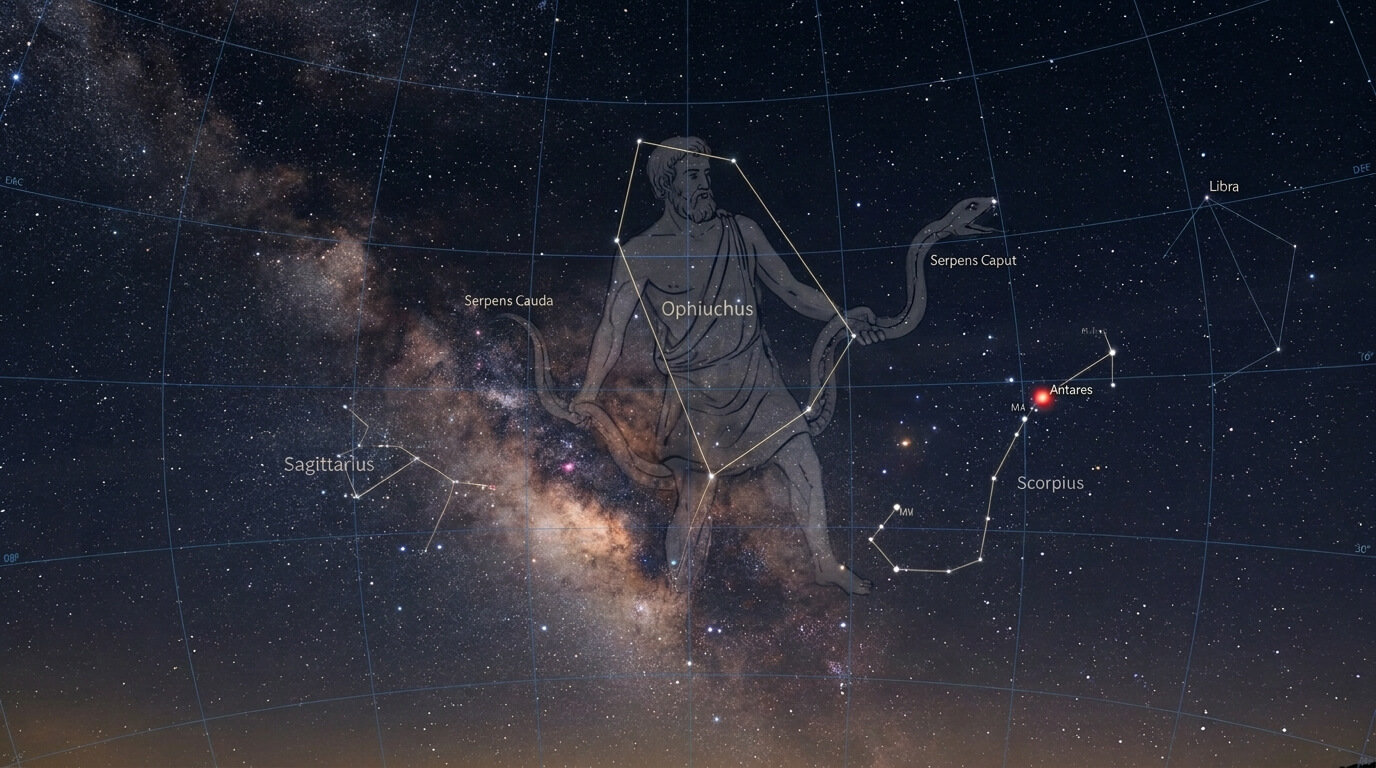
By restoring Ophiuchus in the Sidereal Way, we are returning to a time when the sky was not a mathematical ruler divided into 12 slices, but a living map where the Serpent Bearer occupied its rightful place by merit of its own stellar existence.
At that time, Ophiuchus was identified as Nirah, the Serpent God.
He was not an “intruder” in the zodiac, but a divine messenger and guardian of transitions. He represents wisdom, cunning, healing, and transformation, elements that run through various ancient symbolic traditions linked to the serpent.
While modern astrology ignores it, the records of Nineveh reveal that:
- There was no exclusion
The Assyrians recorded the passage of celestial bodies through Ophiuchus with the same rigor as any other constellation.
- Visual fidelity
They respected the sky as it presented itself. If a constellation occupied more space, this was recognized and incorporated into understanding.
- Ophiuchus as Sentinel
Located between the world of men and the realm of regeneration (near Scorpio), it was perceived as a zone of transition, a symbolic territory where something transforms before being reborn.
The Transition to the Mathematical Zodiac: The Distancing from the Sky
In 612 BCE, Nineveh was sacked and burned. And here one of the most fascinating paradoxes in history emerges: the fire that destroyed the palace was the same that saved the library.
The intense heat baked the clay tablets, transforming them into ceramic resistant to time. What was fragile became permanent.
However, while the records were preserved, the way of interpreting the sky began to change. Fidelity to the real constellations began to be replaced with the rise of the Chaldeans, a Semitic people from the south of Mesopotamia who established the Neo-Babylonian Empire (605–562 BCE) under the command of Nebuchadnezzar II.
From the first millennium B.C., Chaldean astronomers began to give shape to what would later be called the Mathematical Zodiac. This occurred out of a practical need to facilitate ephemeris calculations and organize the calendar. In doing so, they began to abandon the real and unequal dimensions of the constellations, and the ecliptic came to be organized into more regular parts, giving rise to the division into 12 segments of 30°, later consolidated.
This choice brought practicality, but it also brought simplification. And with it, the first great distancing from the real sky.
In this process of “standardization”, Ophiuchus was the first great victim: its territory was “compressed” and distributed between Scorpio and Sagittarius so that the mathematical system could close within the circle of 12 segments.
But the sky was never perfectly divided.
This change marked the beginning of a silent, yet profound separation: the superimposition of a rigid geometric model over the true position of the stars.
Why is Nineveh the Anchor of the Sidereal Way?
Bringing this history into the present is not an exercise in nostalgia. It is an exercise in intellectual honesty.
When we affirm that your real sign may be different from what you have always believed, we are not proposing a new interpretation, we are returning to a more ancient, more faithful, more direct criterion, and more aligned with what can be seen.
We are basing ourselves on the rigor of the observers of Nineveh.
They did not accept a “frozen” or simplified sky. For the sages of Ashurbanipal, truth was not in convenience, it was in observation.
In the Sidereal Way, we recover this tradition. We use the precision that current technology allows us to honor the gaze of those who, 2,700 years ago, already knew that self-knowledge begins with the courage to look at the real sky.
An Invitation to Depth
As you navigate our platform and explore our thematic materials, know that you are accessing information. You are coming into contact with a knowledge that survived the burial of cities, the silence of centuries, and the transformation of civilizations.
You are not just reading a horoscope. You are reading an ancient code.
A code that was considered worthy of being preserved by kings. A code that was not invented, it was observed.
Here, we do not offer simplifications. We offer a return. A return to the roots, to observation, and to the living coherence of the sky.
Welcome.
Your journey does not begin here: it begins again from the real sky.


