Last updated on
Foundations of Sidereal Astrology: The Guide to True Sidereal Astrology
True Sidereal Astrology does not emerge as a passing trend, nor as an impulsive break from tradition. Rather, it represents, above all, a technical, observational, and philosophical return to the sky as it truly is.
More than proposing a “new astrology,” it invites a reconnection with the real constellations and with the true astronomical position of celestial bodies.
This is a fundamental adjustment: a repositioning that restores astrology to its concrete foundation.
This guide is born with that purpose. In a context marked by superficial readings and fragmented interpretations, it establishes a solid starting point, not only to understand True Sidereal Astrology, but to situate it within a broader vision, such as the one we develop in Sidereal Way.
Here, astrology ceases to be merely a symbolic language and becomes also a study anchored in the observable cosmos.
The firmament is not a static backdrop, but a dynamic field, in constant motion and deeply meaningful when observed with precision.
Why does the real sky matter?
True Sidereal Astrology uses actual astronomical coordinates rather than fixed symbolic divisions. This means that the natal chart accurately reflects the position of celestial bodies in the sky at the moment of birth.
This technical detail carries a profound implication.
It reconnects interpretation to observable reality, reestablishing a direct link between symbol and cosmos. Instead of working with fixed projections, the reading begins to engage with a living sky.
Historically, this was the foundation of astrology: observation before interpretation. Over time, this connection was gradually replaced by more abstract models. The return to the real sky is therefore not an innovation: it is a recovery.
And it is at this point that many notice something subtle: when the chart aligns with the real sky, experience itself seems to gain a different kind of coherence, as if certain patterns begin to make more sense when observed from this foundation.
This is particularly noticeable in the repetition of experiences, in the sense of misalignment at certain moments in life, or in the search for a deeper coherence between what is lived and what one is.
The dialogue between Earth and Sky
To understand this shift in perspective, it is necessary to distinguish between the two main astrological reference systems: the Tropical system and the Sidereal system.
Tropical Astrology, widely used in the West, is organized around the cycle of the seasons. Its starting point, 0° Aries, is fixed at the vernal equinox in the Northern Hemisphere. It is, therefore, a system oriented by the rhythm of the Earth.
This structure prioritizes symmetry: the zodiac is divided into 12 equal parts of 30 degrees. This division does not reflect the actual size of the constellations, but rather a mathematical and seasonal organization.
For this reason, its language tends to be more symbolic and psychological, focused on how we experience time, cycles, and environment.
Sidereal Astrology, on the other hand, shifts perspective. Instead of starting from the Earth, it is oriented by the stars, considering a fundamental phenomenon: the precession of the equinoxes,a slow movement of the Earth’s axis that gradually alters our view of the sky over the centuries.
This adjustment allows the chart to remain closer to the current firmament, rather than to a configuration of the past. To understand how these approaches developed, it is necessary to briefly examine the origin of this divergence.
The genesis of divergence
The distinction between Tropical and Sidereal systems did not arise abruptly but was built gradually over time.

Around 130 BCE, Hipparchus of Nicaea identified the precession of the equinoxes by comparing stellar records. He realized that the sky did not remain fixed in relation to the Earth.
Centuries later, Claudius Ptolemy, even aware of this phenomenon, chose to fix the beginning of the zodiac at the vernal equinox. This decision made calculation and teaching easier but introduced an important simplification: the zodiac came to represent a fixed seasonal cycle, while the real sky continued in motion.
With the passage of centuries, this difference has accumulated into a significant shift, which today exceeds 20 degrees. This shift is often described in sidereal systems by the term Ayanamsa.
However, in Sidereal Way, this adjustment is not applied as a symbolic correction but resolved directly through the observation of the actual positions of celestial bodies within the constellations.
True Sidereal Astrology thus emerges as a technical response to this discrepancy: not to invalidate the tropical system, but to restore alignment with the observable sky.
What does “sidereal” mean?
The word “sidereal” derives from the Latin sidus, meaning star.
Adopting this perspective essentially means changing the reference point: shifting from observing the sky through the seasons to observing it through the fixed stars.
Three foundations support this approach:
- the recognition of the precession of the equinoxes
- the observation of the actual positions of celestial bodies
- the use of correction or alignment methods that seek to maintain correspondence with the current sky
These elements allow the chart to approximate a more faithful representation of the real configuration of the sky.
But there is a crucial and often misunderstood point: the term sidereal does not define a single mode of interpretation.
Sidereal Astrology is not one single system
Although they share the same foundation, the stellar sky, different sidereal approaches diverge significantly in method and philosophy.
The Vedic tradition, for example, has preserved for millennia a star-based astrology known as Jyotish. It is a deeply structured system, yet it maintains the classical division of 12 fixed signs of 30 degrees, even when aligned with the sidereal sky.
In the 20th century, researchers such as Cyril Fagan and Donald Bradley brought Sidereal astrology back to the West, known as Western Sidereal Astrology, with a more technical and investigative approach. Even so, most of these branches retained the symmetrical structure of 12 equal divisions.
Over time, some astrologers began to question this symmetry, seeking ways to bring interpretation closer to the real irregularity of the constellations.
This movement, in some approaches, came to be associated with what is now called True Sidereal Astrology, although often through approximations, intermediate models, or partial adjustments.
It is precisely at this point that an essential difference emerges. In Sidereal Way, we do not simply use the sidereal reference: we go one step further.
Sidereal Way: precision and integration
In Sidereal Way, we start from the foundation of True Sidereal Astrology, but refine its application based on a simple principle:
The sky is not symmetrical and interpretation should not be either.
Unlike many sidereal systems that still operate with equal 30-degree divisions, as well as various approaches - including those within what is now referred to as True Sidereal Astrology - that rely on approximations or intermediate models, in the Sidereal Way we work directly with the actual boundaries of the constellations along the ecliptic, respecting their true extent in the sky.
This means recognizing that:
- each constellation occupies a different space in the sky
- the time celestial bodies spend in each one varies
- this irregularity is not an error, it is part of the structure itself
This choice restores a deeper fidelity to the observable cosmos in the natal chart.
Additionally, we integrate the constellation of Ophiuchus as an active part of the interpretative structure. Located between Scorpio and Sagittarius, it represents a point of transition, associated with processes of reorganization, balance, and transformation.
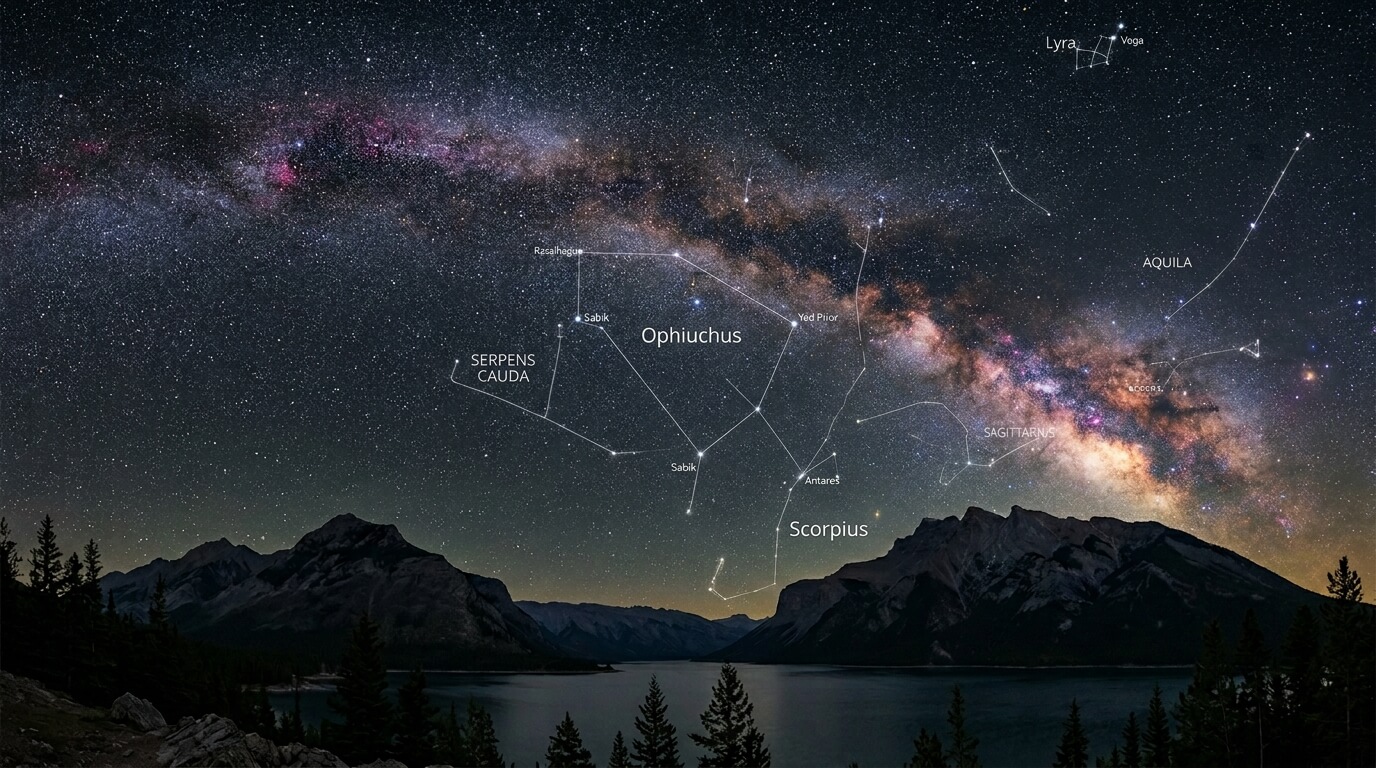
In Sidereal Way, this astronomical foundation is organized within a broader proposal: to understand human experience as a system in motion, where patterns manifest, repeat, and can gradually be recognized and reorganized.
The sky in motion
Observing the real sky implies recognizing that it is in constant transformation.
The precession of the equinoxes reveals that our perspective changes over time. And as we follow this movement, something also reorganizes in the way we understand ourselves.
This happens especially when we begin to recognize repeating patterns, returning tensions, and cycles that seem to call for a new way of reading.
In this context, the presence of Ophiuchus gains a particular symbolic dimension. More than a constellation, it can be understood as a point of transition, a space where tensions reorganize and new balances become possible.
This interpretation is not imposed by the sky but constructed from the way we observe and integrate these patterns.
What makes this approach reliable?
In a field often marked by subjective interpretations, reliability lies in the clarity of its foundations.
In Sidereal Way, this is supported by three pillars:
- a verifiable astronomical basis
- methodological transparency
- coherence in interpretative structure
These elements do not eliminate the complexity of experience, but they offer a more solid starting point for understanding it.
Conclusion: the return to the sky
True Sidereal Astrology is not merely a technical choice, it is a shift in reference. It represents a return to observation, precision, and a direct relationship with the cosmos.
While the Tropical system organizes human time, the real Sidereal system invites us to recognize the time of the sky itself.
In Sidereal Way, this foundation becomes a path to understanding. Not to define who we are, but to understand how we organize ourselves within a greater reality.
And perhaps it is precisely in this reconnection between the sky we see and the experience we have, that astrology begins to reveal its deepest meaning once again.